
Where To Give Now | NRSC v. FEC Implications
I want to provide some context for the recent NRSC v. FEC SCOTUS decision but there’s been some other political news in the last few days (!!!) so I’ll address that first.
Graham Platner needs to drop out immediately. He has consistently lied to Maine’s voters as well as to donors, supporters, and the media about his past. It never should have gotten this far in the first place. And now he is demanding a say in who replaces him. The sheer audacity of him and his team is staggering. As has been widely reported, Platner has until July 13 to drop out then the Maine Democratic Party has until July 27 to replace him on the ballot. I am hearing the party will have a more open process, perhaps even with a mini-caucus, to determine the replacement (rather than just a vote of the Central Committee, which would be the ultimate insider move). I hope the process is transparent and inclusive so outside candidates and a few women are considered (Heather Cos Richardson! Ms. Rachel! , not just an anointment of also-rans who happen to be well-connected.
I hope you will consider supporting The Reckoning Action, a new group that center and support survivors including Jenny Racicot and the Swalwell survivors.
I personally supported Mallory McMarrow’s campaign for the US Senate in Michigan and now I am all-in for Haley Stevens. No, I don’t love that she has the backing of AIPAC. But I believe she fundamentally reflects what Michiganders want (and they don’t want social media fights overshadowing their economic concerns). Abdul El-Sayed has gained momentum but has not distanced himself from problematic endorsers like Hasan Piker and he is obfuscating on everything from his record, to his experience, to his policy positions. The attacks against Haley have been personal and sexist. Do better. The first debate is tonight and I expect a rush of polling ahead of the August 4 primary.
Caveat: I am not a lawyer and this is not legal advice.
On Tuesday, the Supreme Court released their decision in NRSC v. FEC, a campaign finance related decision that overruled coordinated expenditure laws between federal candidates and party committees. There are both short-term and long-term implications for yet another gutting of efforts to reign in big money in politics.
You can read the SCOTUS blog analysis here: https://www.scotusblog.com/2026/06/justices-strike-down-campaign-finance-law/
Prior to the ruling, party committees were limited in how they could coordinate and fund federal candidates. This led to party-supported independent expenditure committees (IEs) that would operate within what is called a firewall at a party committee. So, the DCCC would have one team (A) that worked directly with candidates under a spending cap and another team (B) on the IE side and A could not talk to B and vice versa. This is also separate from the SuperPACs that operate completely on the independent side. Party committees had low limits, ranging from $65,300 to $130,600 for US House candidates to $130,600 to over $4 million, based on population, for US Senate candidates. Staff time and other in-kind donations were closely tracked and paid advertising was at a premium.
All of that has now been overturned. We expect that the FEC will determine that party committees can now receive what is called Lowest Unit Race (LUC) for paid TV and radio advertising, the same as candidate committees. This will likely shift the burden of paid advertising to party committees and it allows mega donors to circumvent the $3,500 per election donation limit through multiple party committee accounts. In essence, major donors can now support a candidate with millions of dollars in coordinated donations instead of the previous limits. Party committees cannot earmark donations for a specific candidate but SuperPACs still can.
This will likely realign 501c4, party committee, candidate, and SuperPAC funding. Outside organizations may take on more non-media expenditures such as research, field, and digital ads while paid TV will be centralized with party committees. There is no longer a cap on candidate expenditures so party committees are free to interfere in primaries to help boost the candidates of their choice (on both sides – boosting their preferred party candidate as well as playing in the other side’s primaries). Candidates and party committees will get creative with shared expenses (Will campaign staff move over to party committee payroll after primaries? Will party committees buy vendor contracts for 100+ races, thus granting additional power to a select group of consultants? Will mass paid ad buys further reduce rates while simultaneously requiring earlier and earlier funding?) There may be increased efficiencies but this definitely hands more power to the party committees and party leaders.
It also complicates the already complex federal campaign finance system. Donation limits remain in place: individual donors can give $3,500 per election per candidate. They can also give $5,000 to Leadership PACs and $10,000 to Joint Fundraising Committees (JFCs), fundraising accounts set up between multiple candidates and/or parties. They can also give a maximum of $10,000 per state federal account. An individual donor cannot give to both a JFC for a specific candidate and to that candidate’s state party federal account. So, for instance, a donor can give $10,000 to Sherrod Brown’s JFC with the DSCC or his JFC with the Ohio Democratic Party or to Emilia Skyes’ JFC with the DCCC or to her JFC with the Ohio Democratic Party or to the Ohio Democratic Party federal account but not more than one entity. This will create an influx of new JFCs, further confusing donors about where and how to give.
Since 2016, Democratic candidates have benefitted from a fundraising advantage due to grassroots donations. Republican party committees can now use their sizable cash advantage to essentially bail out their candidates. The Republican Party also has a 3:1 advantage with mega donors so they have more people to call on to donate millions instead of raising in $10, $20, or $50 monthly increments. As the charts below demonstrate, Republicans have more wealth on their side, more donors who give in large amounts, and more donors who see political giving as an investment towards their business interests rather than altruism.
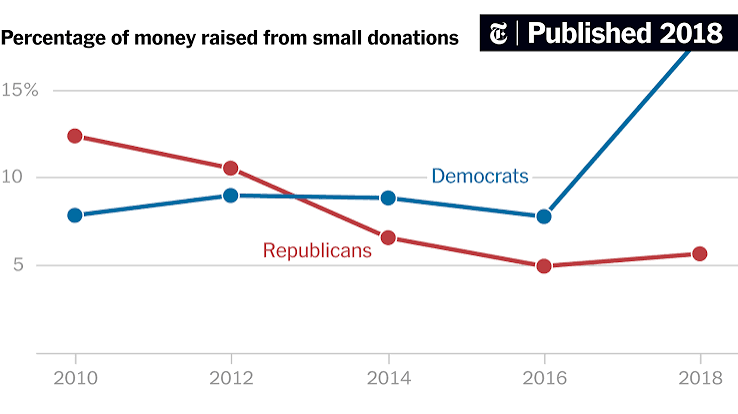
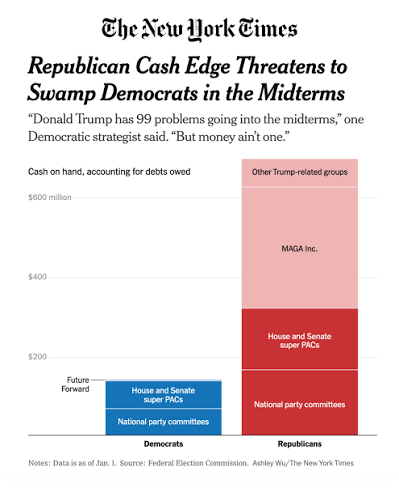
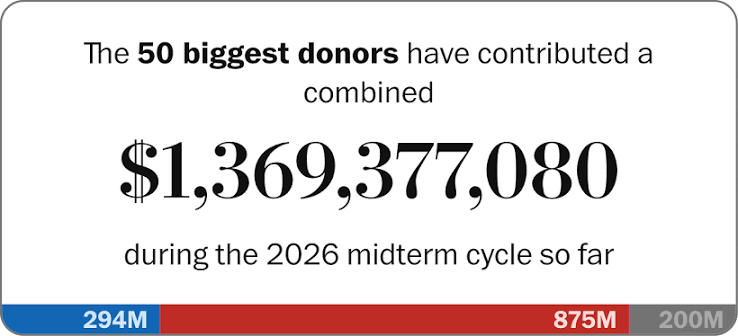
But all hope is not lost! Some of us are old enough to remember the pre-2016 days, when Republicans had a cash advantage. Some of us are even old enough to remember the pre-2002 McCain-Feingold Act when party committees could raise unlimited so-called soft money and Republicans vastly outraised Democrats. And we can all point to numerous instances in recent cycles – including David Trone, Tom Steyer, Michael Bloomberg, and Mehmet Oz, to name a few – of self-funders who poured millions of their own dollars into losing races. We do not need to compete dollar for dollar but we do need enough to be competitive.
This also has broad implications for women candidates and women donors. We know women rely more heavily on women donors who tend to give less than men (about 36 cents on the dollar). There are many more male mega donors than female (and the female mega donors are overwhelmingly married to male spouses). That means more overwhelmingly male donors will have an even bigger say in who wins elections – and that women’s donations, especially pre-primary, will matter even more. Recent research from the Center for American Women in Politics at Rutgers University’s Eagleton Institute finds:
Women are only 39% of unique contributors giving $1,000 or more to Democratic congressional candidates while men are 61% of unique contributors giving $1,000 or more to Democratic candidates;
Women are only 25% of unique contributors giving $1,000 or more to Republican congressional candidates while men are 75% of unique contributors giving $1,000 or more to Republican candidates.
The average donation to Democratic congressional candidates by women is $48 while the average donation to Democratic congressional candidates by men is $87.
The average donation to Republican congressional candidates by women is $39 while the average donation to Republican congressional candidates by men is $106.
As we work to close the gender giving gap and as the great wealth transfer moves trillions into the hands of women, we must de-mystify political giving and help women include candidate donations as part of their giving portfolios.
What does this mean in practical terms for 2026?
Direct to candidate giving is still the most efficient use of your dollar. Candidates can best control where and how to spend that dollar and with what messages and messengers. Party committees will absorb some of this expense but not the unique style of specific campaigns.
This is especially true for down-ballot races where candidate-specific communications matters more than the overall political environment. Non-federal races are still subject to state donation limits and coordination laws.
Party committees now play an even bigger role in our elections. But you should not give to party committees unless/until you have maxed to the candidates of your choice or as an easy button rather than giving to a bunch of candidates directly. You can and should use your major donations as leverage for what you want. While you cannot earmark donations, be clear in the types of candidates you support and the types of tactics you want used (TV ads will still require a huge amount of resources but you can stress field, relational organizing, digital ads, and more).
Maximize pre-primary donations, especially early donations. Primaries are messy! But donors will have more say and sway pre-primary, before a party committee comes in with a heavy hand.
Track donations carefully to avoid exceeding federal limits. If you have maxed to a candidate and want to do more, ask them which JFC to give to and then cross off any additional party donations to that state.
Grassroots donations matter more than ever. We need to self-organize to squeeze every dollar out of every donor and maximize expenditures across campaigns. This does not mean you should only give to the most competitive races; if anything, the opposite is true as media markets in Detroit, Philadelphia, and Phoenix will quickly run out of paid ad inventory. High ROI markets, states, and districts (including longer-shot districts like CO-5, MI-4, MT-1, and others) will play an outsized role.
Buckle up for more uncertainty – but also more creativity. The 2028 election will provide a unique opportunity for experimentation as candidates and party committees explore this brave new world. One day, we will overturn Buckley v. Valeo (it’s the original sin, not Citizens United) and my job will be moot. Until then, bring on the boundary-pushing candidates, consultants, and lawyers who will allow us to experiment within this insane system.